

Golf courses as safe havens for wildlife and biodiversity

Golf courses are often perceived to be detrimental to nature. Last week, Dr Jacinta Humphrey, RMIT University, published an article in The Conversation offering a different point of view. Dr Humphrey explains that the pockets of vegetation between the main grassy areas of golf courses — also known as the “rough” — are often home […]
ICON team members take on ESA 2024

From 9-13 December 2024, multiple ICON team members attended and presented research at the Ecological Society of Australia (ESA) conference held at the Melbourne Convention and Exhibition Centre (MCEC). The ESA conference showcases the science of ecology in Australia and explores connections between science theory, research, policy and on-ground outcomes (ESA 2024). Photo credit: Dr […]
Nature Pledge for Developers: Growing homes, growing nature

Australia needs more housing. But major expansions in residential and commercial developments could pose risks to remaining threatened species habitats, resulting in detrimental consequences for our lives and our country (Biodiversity Council 2024a). In response to this problem, Professor Sarah Bekessy has created a Nature Pledge for Developers to create a framework for developers / […]
Ecology insights for the property sector
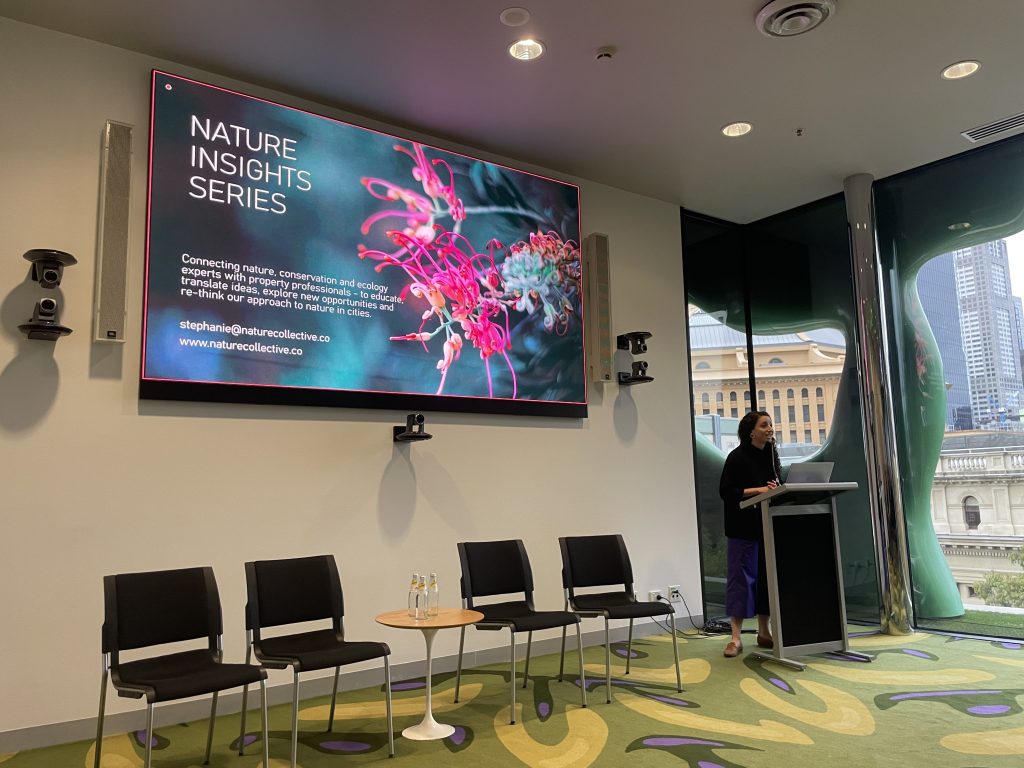
ICON Science recently partnered with Nature Collective to organise the first session of their ‘Nature Insights Series’ entitled ‘Ecology Insights for the Property Sector.’ The Nature Insights Series is led by Nature Collective, a design & consulting practice dedicated to nature-based solutions in the built environment. The intent of the series is to connect nature, […]
In the news: Ensuring equitable access to nature in cities

Catch our own Sarah Bekessy on the Inclusive Agenda podcast. Sarah discusses her recent work on ensuring equitable access to nature in the city for vulnerable communities. Click here
ICON @ ICCB

Every two years members of the Society for Conservation Biology (SCB) hold their scientific conference. The International Congress for Conservation Biology (ICCB) is one of the most important global gatherings for conservation scientists and practitioners. The meeting provides us all with an opportunity to share our work, hear about the latest developments in our field, […]
Enabling Biodiversity Inclusive Design

In the day and age of the biodiversity emergency, architects, landscape architects, urban designers and even engineers are looking for answers to the question “How do we design for biodiversity?”. The ‘Post-2020 Global Biodiversity Framework’ specifically calls for the rise of biodiversity inclusive urban areas (See Target 12, Convention on Biological Diversity 2022). Biodiversity Inclusive […]
Integrating biodiversity as a non-human stakeholder within urban development.

We call this, biodiversity inclusive design. Check out our paper for more information! References
Examining connection to nature at multiple scales provides insights for urban conservation

New research into Melburnians’ connection to nature is helping the City of Melbourne understand how to engage its community members in conservation efforts. The study, led by RMIT University in collaboration with the City of Melbourne and Queensland University of Technology, surveyed over 1,500 City of Melbourne residents and visitors on their connection to nature and found […]
The vast majority of Melburnians want more nature in their city, despite a puzzling north-south divide

When we were asked to survey people in Melbourne about their relationship with nature, little did we know our findings would reinforce a well-known cultural divide between those living north and south of the Yarra River. Residents of neighbourhoods to the south were overall less connected to nature. But perhaps a more important finding was that people in Melbourne […]